Walking with Art in New York: MoMA, Met, Guggenheim
- peopleinsunlight

- Apr 7
- 6 min read
For centuries, the heart of Western art was in Europe: Florence, Rome, Paris, London. But in the 1940s, as artists fled the war seeking a new space of freedom to create, they arrived in New York and forged a new language. The centre of gravity in art shifted, permanently. Since then, New York hasn't just been a city of art; it's become the place where art itself was redefined. That's probably one of the biggest reasons people love this city: art is simply woven into everyday life here. Today, we're talking about three iconic museums whose names are written in bold on New York's art scene. There are already dozens of articles out there listing must-see works, mapping out floor-by-floor routes through these museums. So in this post, you'll find something a little different: some art history, the periods each museum covers, the paintings that stopped me in my tracks, and frames from my own camera. Whether you miss these museums, are planning a visit, or simply want a few quiet minutes with art, let's take a short walk through MoMA, Met, and the Guggenheim together.

MoMA (The Museum of Modern Art)
MoMA is one of the museums that excites me the most. It opened in New York in 1929 as the world's first modern art museum. Behind its founding were three women: Abby Aldrich Rockefeller, Lillie P. Bliss, and Mary Quinn Sullivan. Today, with over 200,000 works, it houses the world's most comprehensive collection of modern and contemporary art, welcoming around 3 million visitors a year.
René Magritte - The Lovers Pablo Picasso - Les Demoiselles d'Avignon Henri Matisse - Dance
MoMA's collection spans art history periods from the 1880s to the present. Its very first exhibition featured Cézanne, Gauguin, Seurat, and Van Gogh, and that was no coincidence; the museum's story begins with Post-Impressionism. The backbone of the modern art period (1880s–1960s) is shaped by Van Gogh and Cézanne in Post-Impressionism, Matisse in Fauvism, Picasso in Cubism, Dalí and Magritte in Surrealism, Klimt in the Vienna Secession, Mondrian in geometric abstraction, and Pollock and Rothko as turning points in Abstract Expressionism. The postmodern era from the 1960s to the 1980s is represented by Warhol and Lichtenstein through Pop Art, while Duchamp's conceptual legacy continues to inspire new generations; "Bicycle Wheel," considered the first ready-made, and "In Advance of the Broken Arm," a snow shovel he bought from a hardware store and declared a work of art, are both at MoMA. In the contemporary art period stretching from the 1980s to today, names like Basquiat and Cindy Sherman carry the collection's strength into the present. MoMA holds a unique place not only for its paintings but also for its photography, film, architecture, and design collections.
Gustav Klimt - Hope II Andy Warhol - Campbell's Soup Cans Salvador Dali - The Persistence of Memory
If I wanted to share every work that stopped me at the museum, I'd need to upload my entire photo gallery from that day, but let me start with the iconic highlights. Van Gogh's "The Starry Night" is probably the most visited painting at MoMA. Picasso's "Les Demoiselles d'Avignon" is considered the painting that launched Cubism; this work that shattered a century of perspective rules in a single stroke was one of the pieces I was most curious to see. Another one I was eager to see was Magritte's "The Lovers"; two figures kissing with their faces covered in cloth. As a child, Magritte found his mother drowned in a river with her face covered in fabric, and the trace of that trauma seeped into nearly every painting he made. "The Lovers" is the most iconic of them. Dalí's "The Persistence of Memory" is the world's most recognised Surrealist image, and when you see it in person, what really surprises you is its size: just 24 x 33 cm. Matisse's "Dance" and "The Red Studio"; colours so vivid, so striking, and that unmistakable Matisse signature you'd recognise anywhere. Rousseau's "The Dream", Klimt's "Hope, II", and of course Warhol's "Campbell's Soup Cans"; 32 canvases, each a different variety, by the man who claimed he had Campbell's soup for lunch every day for twenty years.

Met (The Metropolitan Museum of Art)
One of the largest and most comprehensive museums in the world. Founded in 1870, the Met is an encyclopedic museum that brings over 5,000 years of human history under a single roof. In terms of scope, it's fair to place it alongside the British Museum in London. From Ancient Egyptian sculptures to Renaissance paintings, Japanese armour to American contemporary art, it houses over 2 million works. Its grand Beaux-Arts building right next to Central Park contains an actual Egyptian temple, offers views of Central Park and the New York skyline from its terrace, and is nearly impossible to cover in a single day. With around 6 million visitors a year, it's the most visited museum in the United States.
Johannes Vermeer - Young Woman with a Water Pitcher Jacques Louis David - The Death of Socrates Edgar Degas - The Dance Class
The Met's collection covers a very different range from MoMA. It stretches from Ancient Greece and Rome through the Medieval period, the Renaissance, Baroque, Neoclassicism, Impressionism, and Post-Impressionism. Alongside old masters like Vermeer, Rembrandt, Caravaggio, and El Greco, the giants of the Impressionist and Post-Impressionist era, Monet, Degas, Renoir, Cézanne, Van Gogh, are also powerfully represented here. With dedicated sections for Egyptian, Islamic, Asian, and African art alongside European painting, the Met is less a museum and more a map of civilisation.
Claude Monet - Camille Monet on a Garden Bench Camille Pissarro - The Old Market at Rouen Vincent Van Gogh - Women Picking Olives
There were so many works that stopped me, you find yourself wanting to pause and look at every turn. To list the most striking ones: Vermeer's "Young Woman with a Water Pitcher" is one of the most elegant paintings of the Dutch Golden Age. Jacques-Louis David's "The Death of Socrates" is one of the masterpieces of Neoclassicism; the desperation of his students in his final moment before drinking the poison, the executioner covering his face in shame as he offers the cup, and the elderly Plato at the foot of the bed. Degas, known as the painter of ballerinas, proves with "The Dance Class" that he earned that title for good reason. Van Gogh's "Women Picking Olives", you can't help but admire his brushwork and unmistakable style. Pissarro's "The Old Market at Rouen", one of my favourite painters and the only artist to exhibit at all eight major Impressionist exhibitions held between 1874 and 1886, and Monet's "Camille Monet on a Garden Bench"; Monet painted his own wife Camille in this work.
Guggenheim (Solomon R. Guggenheim Museum)
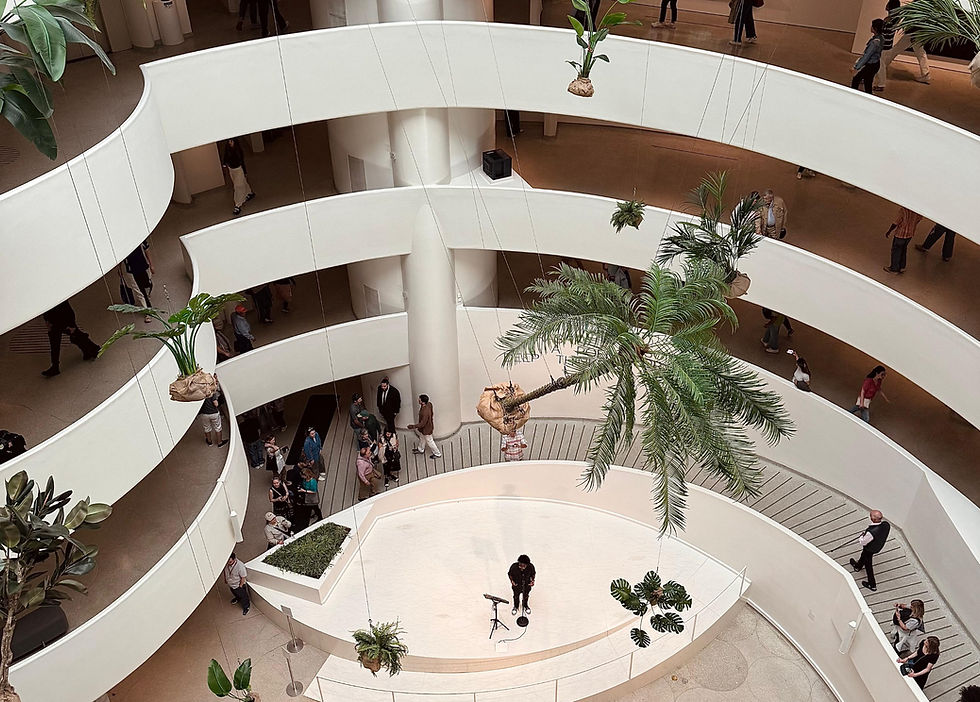
The Guggenheim has a different story from the other two museums. It was founded in 1939 by mining magnate Solomon R. Guggenheim under the name "Museum of Non-Objective Painting." Under the influence of his art advisor Hilla von Rebay, Guggenheim turned toward abstract and non-figurative art, with Kandinsky's paintings forming the foundation of the collection. As the collection grew, the need for a permanent building arose, and in 1943 Rebay wrote a letter to Frank Lloyd Wright asking him to design it: "I need a fighter, a lover of space, an originator." Wright produced over 700 sketches and spent 16 years on the project. When the building opened in 1959, both Guggenheim and Wright had already passed away. At its opening it drew criticism as a "washing machine" and a "giant toilet bowl," but today it sits on the UNESCO World Heritage List and is recognised as a building that permanently changed the course of museum architecture.
Guggenheim Guggenheim Guggenheim
Its biggest difference from MoMA and the Met is the structure of its collection. The Guggenheim holds around 8,000 works, and it's impossible to display them all at once. The only permanent exhibition is the Thannhauser Collection on the second floor, donated to the museum by Justin Thannhauser in 1963; it includes Impressionist and Post-Impressionist works by Degas, Van Gogh, Manet, Picasso, and Cézanne, and is always on view. Beyond that, the museum largely lives through rotating exhibitions. The works you encounter along the spiral ramp can change with every visit.
The greatest strength of the permanent collection, displayed through rotating exhibitions, is that it houses the world's largest Kandinsky collection; over 150 works by Kandinsky, the pioneer of abstract art, are here. Alongside that, the collection includes significant works from Cubism, Surrealism, and Expressionism, with names like Picasso, Chagall, Miró, Mondrian, Pollock, and Lichtenstein. But what truly sets the Guggenheim apart is Wright's spiral building itself. As you walk upward, you rise with the art, the museum's architecture becomes part of the works. That's exactly why the majority of visitors come as much for the building itself as for the art inside it.


Comments